1122334455667788AABBCCDDEE

/ ROOT / STRAIN    ◂ back to sheet 1

Strain

A command-line tool for engineering students: it reads a testing machine's Excel export, works out stress and strain or takes them from the file, fits the modulus over the linear start and plots the curves.

J1Excel export (.xlsx)Find the columnsS1detect_columnINStrain, stress, load andelongation, found by name;labels from file names.Stress and strainS2plot_strain_stress_curveINσ = F / A and ε = ΔL / L0,or the file's own columns.GPa read as MPa.PropertiesS3analyze_material_propertiesINModulus over the linearstart, maximum stress, thelast point as failure.PlotS4--save, --multiple-curvesINPNG and SVG. One curve,or a folder of specimenscompared on one chart.PLOTS▸ Hover a wire to name its net.NET RAW the testing machine's Excel export, one file per specimenNET COLUMNS strain, stress, load and elongation, found by nameNET STRESS, STRAIN σ and ε in MPa and mm/mmNET PROPERTIES modulus, maximum stress and failure, to the plot
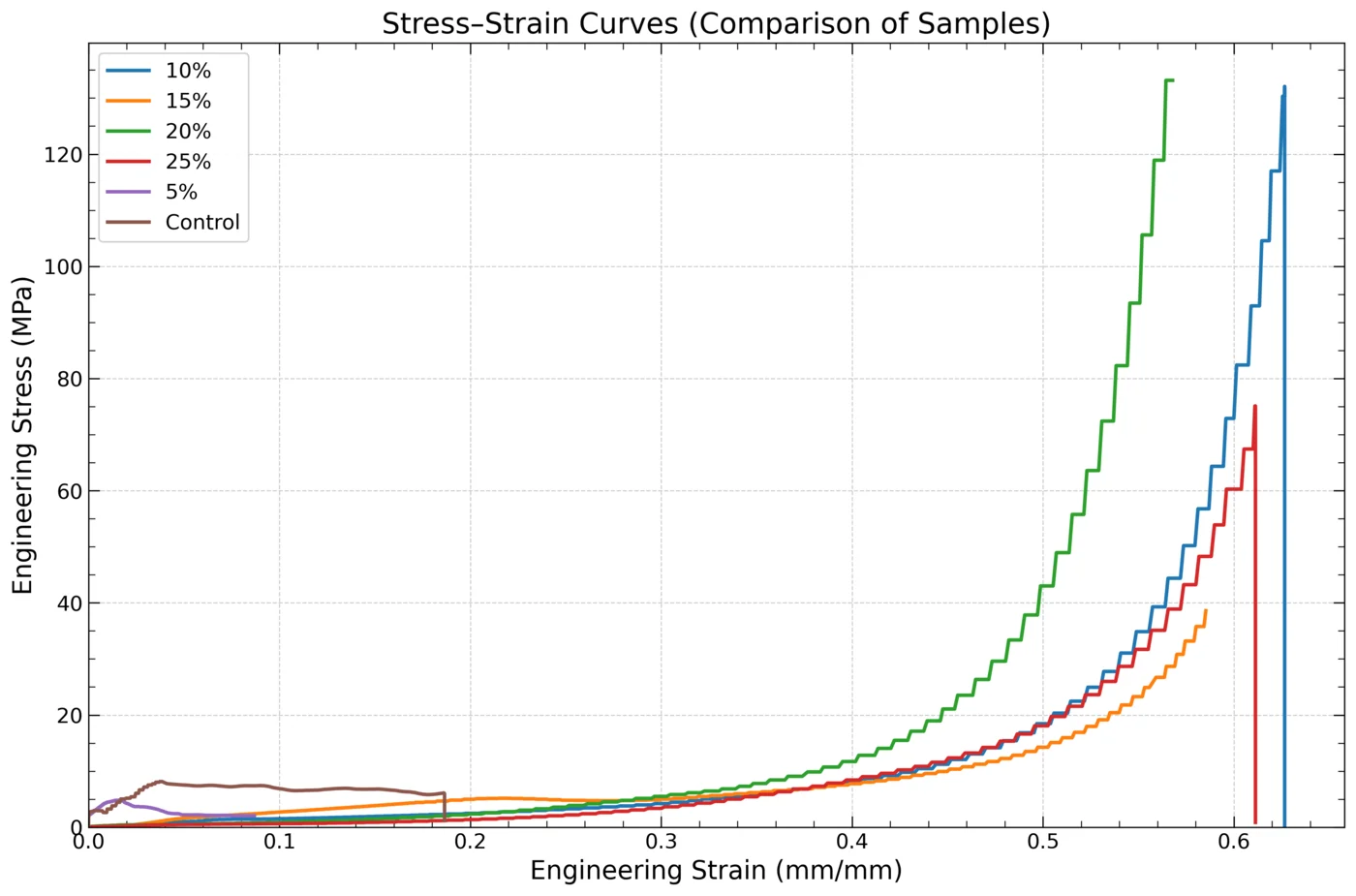
Strain's comparison plot of the compression tests: stress against strain for the control and 5 to 25 percent sisal fibre

FIG. 1  Strain's own comparison plot for the compression tests, unedited: the control and 5 to 25 % sisal fibre.

THE BATCH

Strain was written for the sisal-fibre composite experiment, S4 on sheet 1: a laterite, clay and cement mix with a control and five fibre fractions, tested in bending and in compression by Group 6 in October 2025.

MODES

Tensile, flexural or compression; raw load and elongation with a gauge length and an area, or precomputed stress and strain.

USAGE

python stress_strain_curve.py -p control.xlsx --no-calculation --save python stress_strain_curve.py --multiple-curves --data-directory ./samples --no-calculation --save

METHOD

Drop strain below 0.05 %, fit the modulus by least squares up to the smaller of 0.25 % and a tenth of the maximum.

WRITTEN IN

Python, with pandas, NumPy and Matplotlib.

SOURCE

github.com/kali-physi-hacker/strain, public since 14 December 2025.

REVISIONSREVDATEDESCRIPTIONA2025-11-21First plots: quenched iron, four quenchantsB2025-12-13Sisal composite batch: flexure and compressionC2025-12-14Published on GitHub with a sample runTITLEStrain, stress–strain analysisSHEET/ strainNO.4 of 7REVCDATE2025-12-14DRAWND. BrownSIZEA3GO TO◂ sheet 3sheet 5 ▸OTHER VIEWSDEVPHYSICSACADEMICee.desmondbrown.me

/ ROOT / STRAIN

Strain

A command-line tool for engineering students: it reads a testing machine's Excel export, works out stress and strain or takes them from the file, fits the modulus over the linear start and plots the curves.

SHEET4 of 7REVCDATE2025-12-14
OTHER VIEWSDEVPHYSICSACADEMIC
J1Excel export (.xlsx)Find the columnsS1detect_columnINStrain, stress, load andelongation, found by name;labels from file names.Stress and strainS2plot_strain_stress_curveINσ = F / A and ε = ΔL / L0,or the file's own columns.GPa read as MPa.PropertiesS3analyze_material_propertiesINModulus over the linearstart, maximum stress, thelast point as failure.PlotS4--save, --multiple-curvesINPNG and SVG. One curve,or a folder of specimenscompared on one chart.PLOTS

Drag sideways to follow the pipeline.

Strain's comparison plot of the compression tests: stress against strain for the control and 5 to 25 percent sisal fibre

FIG. 1  Strain's own comparison plot for the compression tests, unedited: the control and 5 to 25 % sisal fibre.

THE BATCH

Strain was written for the sisal-fibre composite experiment, S4 on sheet 1: a laterite, clay and cement mix with a control and five fibre fractions, tested in bending and in compression by Group 6 in October 2025.

MODES

Tensile, flexural or compression; raw load and elongation with a gauge length and an area, or precomputed stress and strain.

USAGE

python stress_strain_curve.py -p control.xlsx --no-calculation --save python stress_strain_curve.py --multiple-curves --data-directory ./samples --no-calculation --save

SOURCE

github.com/kali-physi-hacker/strain

REVISIONS

A2025-11-21First plots: quenched iron, four quenchants
B2025-12-13Sisal composite batch: flexure and compression
C2025-12-14Published on GitHub with a sample run
TITLEStrain, stress–strain analysis
◂ sheet 34 / 7sheet 5 ▸